How Much Food for a Crowd: Per-Person Quantities for 8, 12 and 20 People
By Mel Schembri · Published 2026-09-04 · Hosting
How much food you actually need per person when feeding a crowd. Quantities by dish type for 8, 12 and 20 guests, a one-oven timing plan, and how to stop over-catering by half.
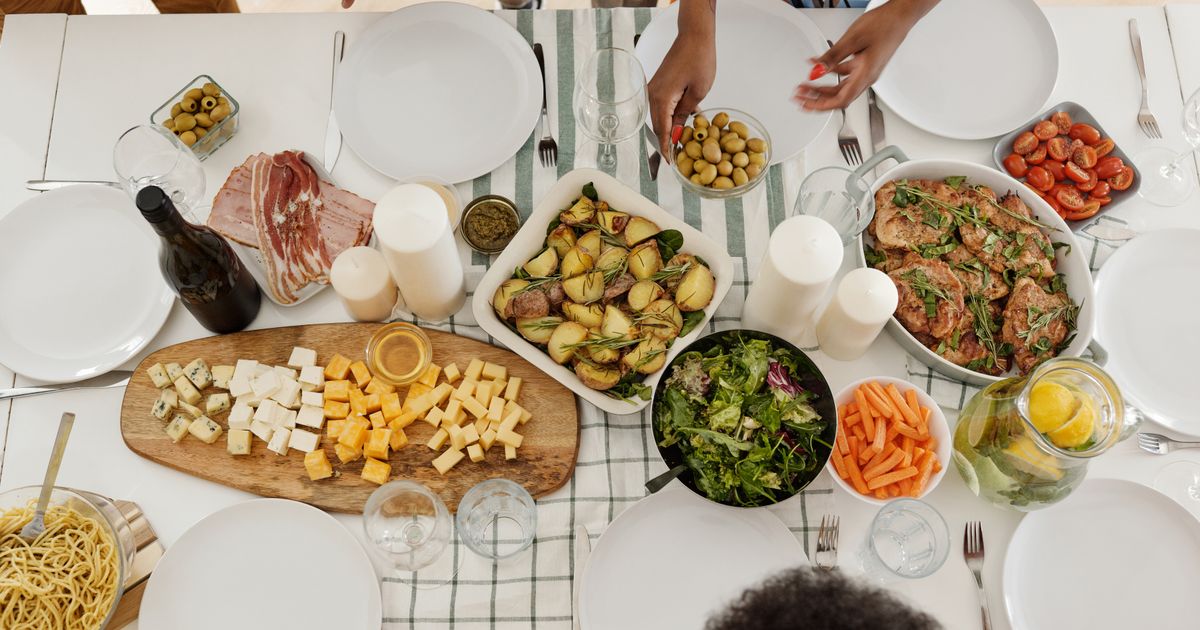
The first time you feed sixteen people, you buy for thirty. Everyone does. You stand in the shop thinking about the one cousin who eats like a rugby team, and you come home with a boot full of food that is still in the fridge on Wednesday.
The second time, you try to be sensible and buy for twelve, and then spend the whole evening watching the potatoes.
There is a middle. It is not complicated, it is just not something anyone tells you. Here are the numbers, by dish type, for 8, 12 and 20 people, and a way to hold the whole plan in one place so you are not doing it in your head at the checkout.
The per-person numbers
These are for adults at a proper sit-down or buffet meal, where the food is the point. If it is a drinks-and-nibbles thing, halve the mains and double the snacks.
| Dish | Per adult | For 8 | For 12 | For 20 |
|---|---|---|---|---|
| Main, boneless (meat, fish, tofu) | 200g | 1.6kg | 2.4kg | 4kg |
| Main, on the bone (chicken pieces, ribs, lamb shoulder) | 350g | 2.8kg | 4.2kg | 7kg |
| Pasta or rice as a side (dry weight) | 70g | 560g | 850g | 1.4kg |
| Pasta as the main (dry weight) | 110g | 900g | 1.3kg | 2.2kg |
| Potatoes | 200g | 1.6kg | 2.4kg | 4kg |
| Each cooked vegetable side | 120g | 1kg | 1.5kg | 2.5kg |
| Salad leaves | 80g | 650g | 1kg | 1.6kg |
| Bread rolls | 1.5 | 12 | 18 | 30 |
| Cheese, as a board | 30g per cheese | 250g | 350g | 600g |
| Dips | 60g | 500g | 700g | 1.2kg |
| Dessert | 1 portion, plus 1 spare per 6 | 10 | 14 | 24 |
| Ice | 500g | 4kg | 6kg | 10kg |
Children under ten count as half. Teenagers count as adults, and the tall ones count as slightly more, but you do not need to plan for that. It evens out.
Two sides, not five
This is the rule that saves the most money and the most stress. When the sides multiply, each one gets a smaller plate share, which means you make 120g per person of five things instead of 120g per person of two, and end up with three times the washing up and the same amount eaten.
Pick two sides that go with the main and do them properly. A third can be a salad, which is cheap and needs no oven. That is the whole plan.
If people are bringing dishes, this is where a potluck goes sideways. Nobody wants to bring the boring side, so you get four desserts and no vegetables. The fix is to name the slots before anyone volunteers. Two sides, one salad, one bread, two desserts, and they go on the list before the day, not in the group chat at six o'clock. A Thanksgiving potluck is the classic version of this problem.
Buffet or plated
A plated meal is easier to size because you control the portion. A buffet needs a little more, because the first ten people through the line take a bit more than their share and the last five get what is left.
Add ten percent to the mains for a buffet. Do not add anything to the sides. Put the expensive thing furthest from the start of the line, because plates fill up in order.
What actually runs out
Hosts worry about running out of food. What actually happens is running out of one dish. The roast potatoes go in nine minutes. The green beans are untouched.
So instead of adding a bit to everything, add a lot to the one thing you know goes first. Twenty percent more potatoes, and nothing more of anything else, beats ten percent more of every dish.
If you are feeding a crowd regularly and want to cut the bill as well, the numbers here pair well with feeding a crowd on a budget, which is about which dishes to choose, not how much of them.
Feeding a crowd with one oven
This is the constraint nobody plans for. Most home ovens fit one large tray at a time, and if the main, the potatoes, and the gratin all need the oven at 200C for the last forty minutes, somebody is eating lukewarm.
The way through it:
- One dish owns the oven at serving time. Usually the main. Everything else is done before it goes in.
- Roast the sides the day before. Potatoes, root vegetables, anything tray-baked. They reheat better than most people expect, covered, at 160C for 25 minutes, while the main rests.
- Move one side off the oven entirely. Slow cooker, hob, or cold. A big grain salad or a braise that has been sitting since morning does not care what the oven is doing.
- Rest the main for longer than you think. A joint or a whole bird holds heat for 30 to 40 minutes under foil. That is your reheating window.
- Serve the oven dish last. Get everything else on the table, then bring the main out. Nobody has ever complained that the roast arrived two minutes after the potatoes.
If two of you are cooking in two kitchens, split by oven. One house does the main and one does everything roasted. It is the single biggest reason to divide a big meal across households rather than one person doing it all.
When everyone eats differently
The quantities above assume one menu. Once there is a vegan, a coeliac, and someone who cannot do dairy, you are not sizing one meal, you are sizing three overlapping ones, and it is easy to end up with a sad plate for the person with the restriction and a mountain for everyone else.
The short version: make one of your two sides naturally suitable for everyone, so the person with the restriction is eating the same thing as the table, not a separate portion. The long version is in hosting a group dinner when everyone has a dietary restriction.
Keeping the plan out of your head
The numbers are the easy bit. The hard bit is the version of this that lives in your head for a week: how many are coming, who has said yes, whether the vegetarian count went from two to four, and whether anyone has claimed the bread.
The reason this goes wrong at a potluck or a big family lunch is that the headcount, the dish list, and the dietary needs live in three places. Someone messages you privately to say they are bringing a plus one. Someone else changes their dish in the group chat. By Saturday you are re-counting.
GetLadle keeps those three things on one event. Guests RSVP and the headcount updates itself. Dishes get claimed against named slots, so you can see the two sides are covered and the fourth dessert is not needed. Dietary needs sit on the guest, not in your memory. When the number changes from 12 to 15 on Friday, you can see it and use the per-person guide above to update your quantities.
You still have to cook. You just do not have to hold it all in your head while you do.
Start coordinating your group meals. Try GetLadle free and set up your next event with the headcount, the dish list, and the dietary needs in one place.
Frequently asked questions
How much food do I need per person for a party?
Plan 200g of boneless main protein per adult, or 350g if it is on the bone. Two sides at 120g each, a large handful of salad, one and a half bread rolls, and one dessert portion. Count children under ten as half a person. Add ten percent if the meal is a buffet rather than plated.
How much food do I need for 12 people?
For 12 adults, plan roughly 2.4kg of boneless meat or fish, 1.5kg each of two sides, 1kg of salad leaves, 18 bread rolls, and 14 dessert portions. If it is a potluck, split those totals across the people bringing dishes rather than asking each of them to feed 12.
How much food do I need for 20 guests?
For 20 adults, plan about 4kg of boneless main, 2.5kg each of two sides, 1.6kg of salad leaves, 30 rolls, and 24 dessert portions. At this size you are almost certainly running a buffet, so add ten percent to the mains and drop to two sides rather than four.
How do I feed a crowd with only one oven?
Pick one dish that needs the oven at serving time and make everything else ahead, in a slow cooker, on the hob, or cold. Roast or bake the ahead dishes the day before, reheat them covered at 160C for 25 minutes while the main rests, and serve the oven dish last.
Should I cook more if some guests are big eaters?
No. Big eaters and light eaters cancel out across a group of eight or more. The quantities above already include a small buffer. The thing that actually causes shortages is running out of one popular dish, not running out of food overall, so make a bit more of the dish you expect to go first rather than more of everything.