Dinner party ideas that make hosting easier, from menu to washing up
The dinner party ideas that work best make the night easier for the host: a menu you can mostly make ahead, dishes that share one oven temperature, one course bought in, food served family style, and dietary needs collected with the RSVP instead of at the door. Six to eight guests suits one table and one conversation. Three courses is plenty: something to pick at with drinks, a main with two sides, and a dessert. Set the menu five days ahead, shop three days ahead, cook what keeps the day before, and stop cooking thirty minutes before the doorbell goes.
A good dinner party menu is one where most of the cooking is finished before the first guest arrives.
Why most dinner party ideas make hosting harder
A dinner party is the one meal where you cook everything and still have to look relaxed when the doorbell goes. The food is the easy part. What goes wrong is everything around it: the guest who mentions a nut allergy on arrival, the two dishes that both need the oven at 7, the shopping list that only ever existed in your head.
Most dinner party ideas add work: a fourth course, a signature cocktail, a themed table. The ideas below take work away.
Dinner party ideas that make the night easier
Pick a menu you can mostly make ahead. A braise, a tray bake, a tart, anything that sits happily in a low oven. Save the one dish that needs last-minute attention for the course where you are already in the kitchen anyway.
Buy one course. Good bread and cheese is a dessert. A plate of excellent olives and some salted almonds is a starter. Nobody has ever left a dinner party saying the host should have made her own crackers.
Choose dishes that share an oven temperature. Two dishes at 180°C (350°F) and one at 220°C (425°F) is a timing problem. Three dishes at 180°C is a dinner.
Ask about dietary needs on the invitation. Most people will not volunteer an intolerance until the plate is in front of them. Ask once, in writing, when they RSVP, and build the menu around the answers.
Set the table the night before. Plates, glasses, cutlery, napkins, candles, water jugs. On the day you only have to light things.
Decide what guests bring before they ask. They will ask. Have an answer ready: wine, a dessert, nothing at all. Writing it on the invitation saves the five-message conversation.
Serve family style. Big platters in the middle of the table mean one trip from the kitchen, no plating under pressure, and seconds without you getting up.
Dinner party menu ideas
Four menus built on those rules. Each one has a single oven temperature and one dish at most that needs you on the night.
| Menu | With drinks | Main and sides | Dessert |
|---|---|---|---|
| The make-ahead braise | Marinated olives, salted almonds | Braised short rib or chicken in white wine, mash or polenta, a green salad | Chocolate pots, made the day before |
| The tray bake | Whipped feta with flatbread | Sausages or chicken thighs roasted with squash and red onion, a grain salad | A fruit crumble that bakes while you eat |
| The vegetarian table | Crudités and hummus | Baked gnocchi or a squash and bean stew, garlic bread, a bitter leaf salad | Lemon tart, bought or made |
| The mostly bought | A cheese and charcuterie board | One good roast chicken, potatoes cooked in the same tin, dressed leaves | Ice cream with a warm sauce |
If you are planning a dinner party menu for guests you do not know well, the vegetarian table is the safest starting point. It is easier to add a side of meat for some than to rebuild a menu around one guest.
Hosting a dinner party: the timeline
- A week or more ahead: send one link. Date, time, address, and a line asking for dietary needs.
- Five days ahead: set the menu. Three or four dishes, most of them make-ahead. Check the RSVPs for allergies and swap anything that needs swapping now, while it costs nothing.
- Three days ahead: write the shopping list. From the menu, grouped by where things are in the shop. Order what can be delivered. Buy the wine.
- The day before: cook what keeps. The braise, the dessert, the dressing, anything that improves overnight. Set the table.
- The morning of: prep the rest. Vegetables washed and chopped, cheese out of the fridge an hour before serving, drinks cold.
- Thirty minutes before: stop cooking. Light the candles, put music on, pour yourself a glass. If the oven timeline was right, the food looks after itself from here.
- Afterwards: save what worked. The menu that went down well is next time's starting point.
How GetLadle handles a dinner party
GetLadle is a group meal coordination app. For a dinner party, that means three things.
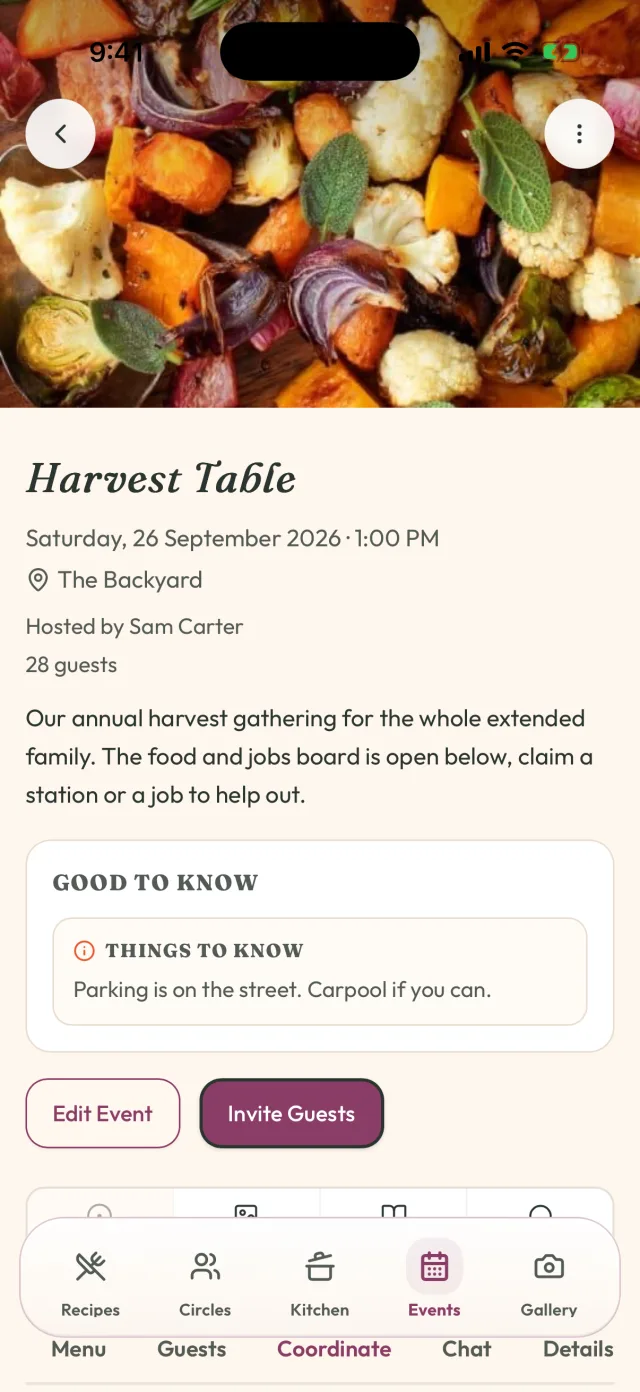
One link, no app for guests. You create the event and send the link by text, WhatsApp or email. Guests RSVP in their browser and note any dietary needs in the same step. You see the headcount and every dietary note on one page before you plan the menu.
The menu becomes the plan. Add your recipes to the event and to the week's meal plan. On Sous Chef and Head Chef the shopping list builds itself from the plan. Cook Mode walks each recipe on the day with its own timers, so nothing is forgotten in a hot oven while you are opening the door.
It remembers. The event cookbook keeps what you cooked, so "what did we serve last time" has an answer.
A free Apprentice account covers up to 25 guests per event. Sous Chef covers 25. Head Chef includes unlimited guests and the host toolkit, for the rare dinner that turns into a crowd.
More dinner party planning
If someone at the table has a restriction you have never cooked for, read hosting a group dinner when everyone has a dietary restriction. To know how much to make, see how much food for a crowd. For the first course, see make-ahead appetizers for a party. For the step-by-step version of the invitation, read how to host a dinner party without the group chat chaos.
Frequently asked questions
How many courses should a dinner party have?
Three is plenty: something to pick at with drinks, a main with one or two sides served family style, and a dessert. Four or more means you spend the evening in the kitchen. If you want to add a course, make it a cheese board, which involves no cooking.
How far ahead can I cook for a dinner party?
Braises, stews, curries and most desserts are better made the day before. USDA FSIS guidance gives cooked dishes three to four days in the fridge, so anything finished two days ahead is comfortably inside the window. Salads and anything fried or seared are same-day jobs.
How many people should I invite to a dinner party?
Six to eight is the sweet spot: one conversation at the table, one pan of most things, and it fits a normal oven. Beyond ten you are cooking for a crowd, and the menu should change with it.
What do I say when a guest asks what to bring?
Decide before they ask and put it on the invitation. Wine is the easy answer, a dessert is the generous one. If you would rather they brought nothing, say so plainly. People are relieved to be told.
What if someone tells me about an allergy on the day?
Keep one dish on the menu that is naturally free of the common allergens (nuts, dairy, gluten, shellfish) so there is always something they can eat. Then ask on the invitation next time, so it does not happen again.
Can GetLadle collect RSVPs and dietary needs for a dinner party?
Yes. You create an event and send one link. Guests RSVP in their browser and note any dietary needs in the same step, with no app or account needed on their side. You see the headcount and every dietary note on one page.
Related
- How to Host a Dinner Party Without the Group Chat Chaos
- Hosting a Group Dinner When Everyone Has a Dietary Restriction
- How Much Food for a Crowd: Per-Person Quantities for 8, 12 and 20 People
- The Best Dinner Party Planning App: Host Without the Stress
- Make-Ahead Appetizers for a Party: Ideas That Travel
- Christmas Dinner Ideas for Hosts: Menu and Who Brings What
Sources
Last reviewed 2026-11-26 · GetLadle