Splitting the dinner decision between two people, not one
To meal plan as a couple without one person carrying the whole job, make the plan itself shared and visible, not just the cooking. The person who ends up deciding what's for dinner every night is usually the one who happens to hold the plan in their head, and that defaults to whoever started doing it first. Put the week's meals somewhere both people can see and edit, split who plans which nights, and let the shopping list build itself from the plan so neither person has to remember it separately.
It's rarely an unwillingness to help — it's that only one person can see the plan.
Why it lands on one person
"What's for dinner?" is a small question asked every day, and someone has to hold the answer. A Mumsnet thread on the topic describes it well: it "is one of the most draining parts of ordinary life," not because cooking itself is hard, but because deciding is a constant, low-grade task that never fully switches off. Another reply put it more sharply: "it's part of the mental load and the impact shouldn't be underestimated."
This usually isn't one partner refusing to help. It's that the plan — if it exists at all — lives in one person's head, so the other person has nothing to look at, add to, or take over for a night. Whoever started keeping track keeps doing it, by default rather than by agreement.
Step 1: Get the plan out of one person's head
Write the week down somewhere both people can see, before either of you decides what to cook on any given night. A shared, visible plan is the actual fix — splitting cooking duties without a shared plan just moves the mental load around instead of removing it.
Step 2: Split who plans, not just who cooks
One approach that works for couples managing this well: each person plays to what they prefer. One plans the week, the other handles the shop or the actual cooking on a given night — as long as both can see and adjust the whole plan, not just their own piece of it.
Step 3: Let the shopping list follow the plan
A plan that doesn't produce a shopping list still leaves someone doing the "what do we actually need" translation by hand. Build the list from the plan itself so neither person has to hold that step separately.
Step 4: Revisit it together, briefly, once a week
A short weekly check-in — ten minutes on a Sunday — keeps the plan a shared thing rather than one person's chore that the other occasionally glances at. One commenter meal plans "6 weeks at a time" precisely to avoid the nightly negotiation altogether.
How GetLadle handles this
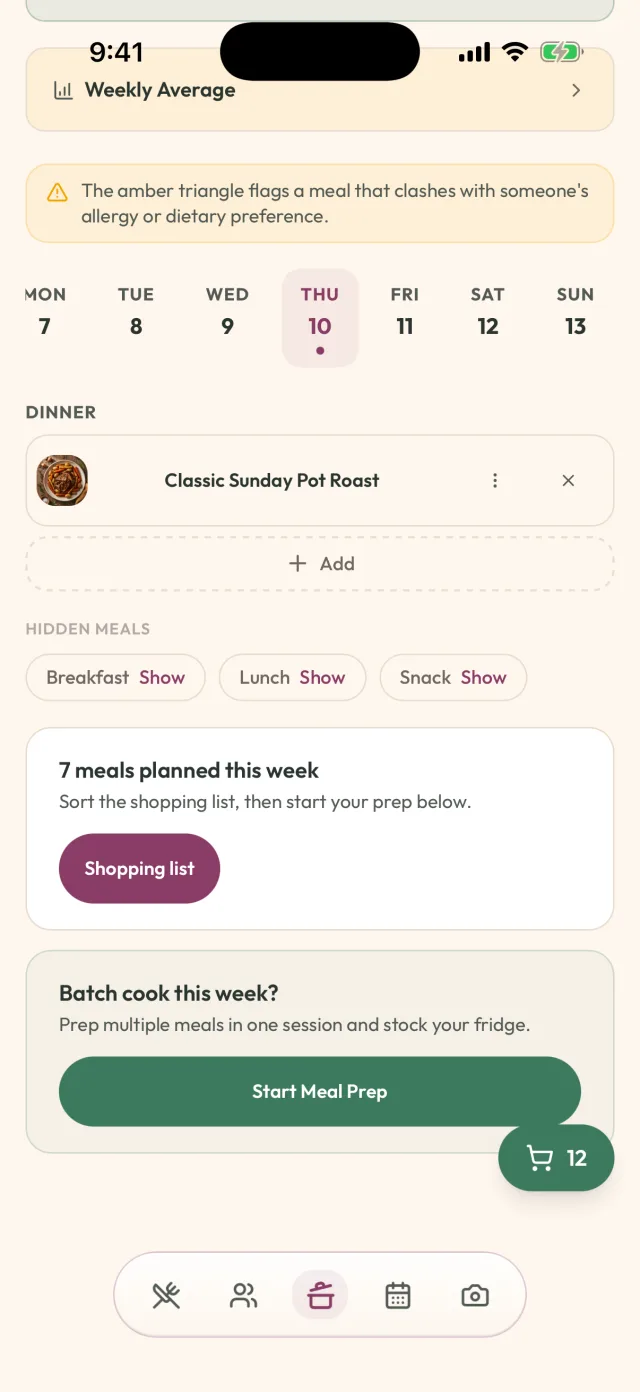
GetLadle's meal planner is a weekly grid both people in a household can see and edit — not a note in one person's phone. Add up to four household members on Sous Chef, or unlimited on Head Chef (Apprentice includes one), so a partner sees and can change the same plan you're looking at. The shopping list builds automatically from what's planned on Sous Chef and Head Chef; Apprentice includes a manual list. Sous Chef and Head Chef also add a "Fill My Week" option that auto-suggests a week's meals when neither of you has the energy to start from a blank grid.
When the plan needs to flex
Plans change — a late meeting, a takeaway night nobody wants to admit they wanted. Treat a shared plan as a starting point you both can edit, not a contract, and the person who didn't set the original plan can adjust it without having to ask permission first.
Frequently asked questions
Why does meal planning end up falling on one person in a couple?
Because the plan usually lives in one person's head rather than somewhere both people can see. Whoever started keeping track keeps doing it by default, not because their partner refuses to help — the other person simply has nothing to look at or add to.
How do couples split meal planning fairly?
A common approach from couples managing this well is playing to preference: one person plans, the other shops or cooks, and both can see the whole week rather than only their piece of it. What matters more than the exact split is that the plan itself is visible to both people, not just one.
Does a shared meal plan actually save time?
It removes the daily negotiation more than it saves minutes on any single task. One Mumsnet commenter who meal plans in advance described the whole week's decisions taking 'less than half an hour' once, rather than a nightly back-and-forth over what to make.
Related
- How to cook from the fridge without a wasted grocery trip
- How to share family recipes without retyping them
- Meal Planning for Families: The Simple System That Actually Works
- The Best Group Meal Planning App in 2026
- Compare GetLadle
Sources
- Mumsnet: worn down by deciding what to make for dinner daily
- Mumsnet: what's equitable to the mental load of food planning
Last reviewed 2026-09-15 · GetLadle